Date: 20 October, 2025
Status: Confidential, Not for publication – Please treat all materials with confidentiality.
Contact:
Feel welcome to get in touch with executive producer Angharad Cooper, angharad.cooper@gmail.com, or composer Jobina Tinnemans mail@jobinatinnemans.com
A more detailed production plan is available on request.
A Hundred Thousand Good Nights
a new opera with music and words by Jobina Tinnemans
The story, created from real voices by our ancestors sending us their kind wishes and warnings, finds five people on deck of a ship with only one thing in common: a head full of promises to grasp onto amongst the raging seas, their hands clutching a chorus of letters revealing their past, present and future. Folded pieces of paper swarm overseas like flocks of migratory origami birds, written messages crossing the globe very much like our own, what did they say and what did it matter? Life on a ship in the 17th century was restless and busy, surrounded by thundering weather, hammering waves and whirling wildlife. Layers of sequenced arpeggios, feeding and breaking one another, will surround our characters generating a lively, bold and immersive sound world.
Video: A Hundred Thousand Good Nights pre-production trailer, ca. 2 minutes, with excerpts of Songs That Never Come Ashore (2024)
Duration: ca. 140 minutes
Instrumentation: main characters – soprano, mezzo-soprano, alto, tenor, bass, chorus – soprano, mezzo-soprano, alto, tenor, baritone, bass, and 2x violin, 2x viola, 2x cello, flute (doubling piccolo), clarinet (doubling bass), alto and tenor saxophones, French horn, cymbalom, percussion
Main characters:
Catalina – loosely based on Catalina Trico, who was the first female settler on the Manhattan planted colony, originating from the French-speaking Southern Netherlands.
Hemma – this fictional character represents those who stayed at home while relatives cross the Atlantic.
Captain Margriet – loosely based upon a female captain described in a travel journal from 1679. Margret is greedy, a debt collector and could be mistaken for Mephisto.
Theo (Theophilus Fust) – a fictional character of someone engaging in the latest money maker.
Vorstmans – we don’t know his first name, we don’t really know who he is. This fictional character is loosely based on Jasper Danckaerts, closely observing the world in 1679.
Real voices from the archives
“The Prize Papers archive is the home of a cacophony of voices in silent ink on paper. Composer Jobina Tinnemans is bringing these first-hand accounts back to life in an exciting opera production.” Prize Papers Project, The National Archives London
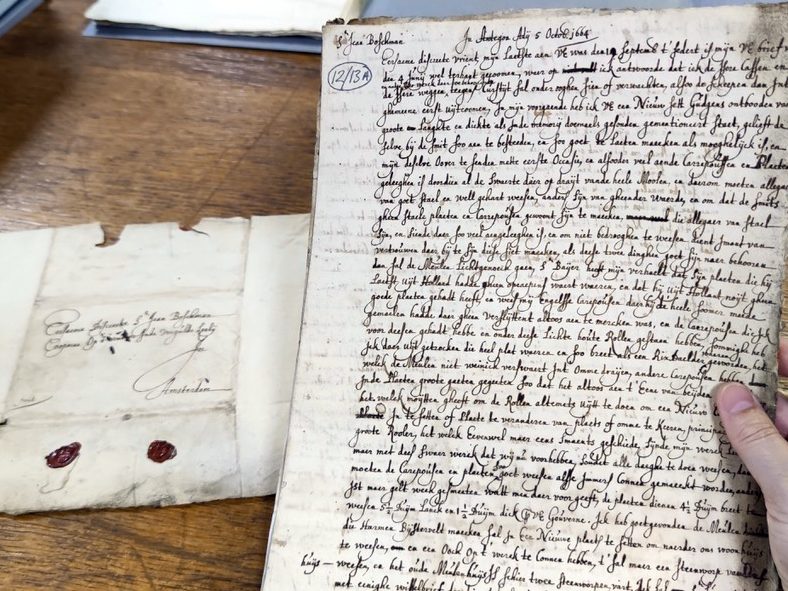
transcription work at The National Archives
In the second Anglo-Dutch war of 1664, the English confiscated Dutch ships amongst other nations as prizes. The admin and personal letters on board of these ships were stored in the Tower of London for several centuries and have made their way to The National Archives where they are currently archived.
Commissioned by the Prize Papers Project of department of Social Sciences of the University of Oldenburg, Jobina Tinnemans transcribed 207 prized letters. As these letters never reached their destination, they have never been read or heard before and with this opera Tinnemans wants to bring back to life these valuable first-hand accounts depicting the emotional world of ordinary people’s lives in a turmoil of rapidly shifting world-affairs:
“Even though the majority of the 17th century letters arriving on my desk for transcription signal levels of upset by relatives and friends, such emotions were never taken into account as a genuine player in the concept of trading. The costing of trading goods would have looked very different if, right from the start, we would have applied mechanisms to quantify human distress and environmental impact as an expense into trading equations, inevitably resulting in some of those trading goods not being profitable enough to pursue.” – Jobina Tinnemans
Title
“I wish you a hundred thousand good nights” is how the majority of the transcribed letters were closed. The writer would wish every family member and friend a good night, with the most precious people receiving a hundred thousand good nights and a hundred thousand more.
The wish “A hundred thousand good nights and a hundred thousand more” connects to our present day: 100,000 nights are 274 years, which takes us to the year 1938 from 1664, and a 100,000 more takes us to the year 2212, which means we still make part of their well-wishing.
Synopsis
It is the 17th century. We begin at the very moment that the main female character Catalina sets an unsteady foot off the gangplank on which she married a deckhand, leaving her wartime home for a gruelling voyage across the sea. The inland wind from the North is smelling of a vastness that is startlingly unfamiliar.
Visual plot
Parallel to the main storyline will be a wordless narrative, performed in a choreography of daily chores folding sheets, linnen and paper (image below) which initially gains only passing attention, until it comes into focus in a mondaine contradiction.

Still image of Turner Piece II (2020) for page turning, sound art composition utilising the turning of paper pages. See it in action in the video in the above.
Music Examples
Songs That Never Come Ashore (2024)
Commissioned by Simffoni Mara with première performance by soprano Georgina Stalbow, accompanied by David Pepper (piano) and Daniel Davies (cello) in Theatr Gwaun, Fishguard, September 22, 2024. Next performance October 18, 2025, at the Wexford Opera Festival, Ireland.
(recordings of the première performance are in the soundtrack of the pre-production trailer video at the top of this page)
These three songs were written for the local community of Fishguard, adopted home of the composer, with the titles 49 knots, Write With the First and A Great Fire, But No Land, doubling as an introduction to the opera A Hundred Thousand Good Nights.
How we are all connected
The song Write With The First quotes from a letter by a writer on board of a ship making its way from Amsterdam to New Amsterdam, in which he mentions that they are making a stop in Dublin to pick up horses. This little mention means that they sailed up the Irish Sea and passed Fishguard Harbour and that, perhaps, an ancestor of someone in the audience during the première performance at Theatr Gwaun might have seen the ship going around Strumble Head.
The image below pictures another citation that found its way into Write With The First. It says “het is hier oock slecht ende de menschen die sterfen haestich in een dach oft 2 gesonten doodt”, which loosely translates as “things are also very bad here, people die fast, in two days the good are dead”. These people were most likely suffering from the bubonic plague.

The full score of Songs That Never Come Ashore (2024) for your perusal.
Acknowledgements
All concepts and ideas are originated by Jobina Tinnemans following her 2020-2025 research into the Prize Papers at The National Archives, Kew, and into primary and secondary published resources such as books, poetry, folk legends, research papers and maps, with regards to 17th century Netherlands, Cross-Atlantic Trade and New Netherland; concepts of indigenous languages and etymology of words across languages present in New Netherland and indigenous place names and their meanings*;
as well as by in person interviews with transcriber Charles Gehring and geologist Chelsea Teale from the New Netherland Institute in Albany NY; academic historians Jaap Jacobs, who is internationally recognised as the top specialist on New Netherland, Oliver Finnegan at The National Archives, Amanda E. Faulkner and Drew Lipman from Columbia University NYC; Toya Dubin, developer of an interactive model of New Amsterdam in collaboration with the New York Historical Society; Oscar Hefting of the New Holland Foundation in Amsterdam; geologist Sid Howells in Wales, author and music journalist Philip Clarke, The Writer’s Award Winner of the British Library;
and by in person visits to historical places of interest in New York, formerly known New Amsterdam, to upstate New York, formerly known as New Netherland, and to Albany, formerly known as Rensselaerswijck; and to places of environmental interest up the Hudson River, between New York City and Albany being of major importance to New Nederland’s existence with visits to Stony Point, Germantown, Haverstraw and Poughkeepsie, present-day remote seascape impressions in Pembrokeshire and a place of New Netherland related ship wreck at The Mumbles in Wales;
and by in person visits to places of cultural study in The National Museum Of The American Indian in NYC, MoMa PS1 exhibition of Navajo textile artist Melissa Cody, New York Historical Society, V&A museum in London, British Museum in London, National Maritime Museum in London, The Wallace Collection in London, Portsmouth Historic Dockyard, Rijksmuseum in Amsterdam, Mauritshuis in Den Haag.
Commissioned by the German University of Oldenburg’s Prize Papers Project in 2023, Jobina Tinnemans transcribed 207 letters / 281 pages on A4 of Dutch letters from the Prize Papers Archive at The National Archives, Kew, as part of the R&D for the opera production.
The composition of Vanitas (2024) for string quartet has received support from the Hinrichsen Foundation and the Vaughan Williams Foundation.
The triptych Songs That Never Come Ashore (2024) was a Simffoni Mara commission.
* A reading list will be included in the research references publication as part of the libretto.
Presentations
There are planned presentations of a selection of songs from the opera:
- British Library, second quarter of 2026
- South Street Seaport Museum, NYC
Copyright ©2025 by Jobina Tinnemans
 JOBINA TINNEMANS